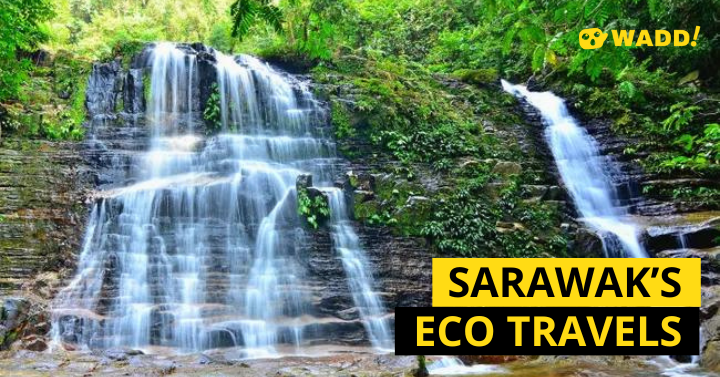

Kaul Festival is a traditional festival celebrated by the Melanaus living in along the coast of Sarawak. Kaul means "coming together" in Melanau.
In the past, Kaul was looked upon as a religious ceremony to appease the Ipok - spirits of the sea, land, forest and farm. It is the most important festival of the Melanau year. It is a ritual of purification and thanksgiving as well as one of the propitiation for good fortune. It is held at the beginning of the Melanau calendar marked by the monsoons which affected their livelihood as farmers and fishers.
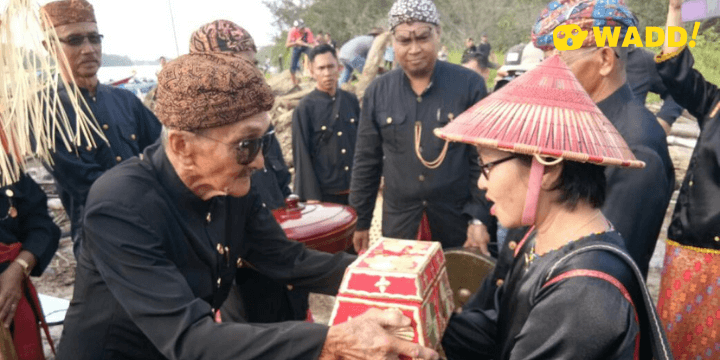
Image source via FB/Persatuan Melanau Sarawak
The conversion of Melanaus's region to Islam and Christianity, however, has turned the practised into a social-cultural gathering rather than a religious ceremony. Nevertheless, the essence of the festival is still intact. The rituals associated with Kaul are always carried out, though more as a cultural appreciation. As such, Kaul is put on the Sarawak Tourism's Calendar of Events - among the colourful ethnics festivals celebrated by the people of Sarawak, making it to be the one of tourist attraction for State. The event is scheduled to fall in the month of April every year on the bank of Mukah river mouth.
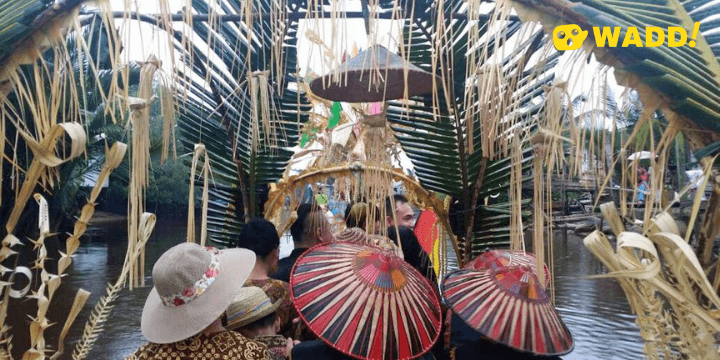
Image source via FB/catsfm
Among the highlights in Kaul are the Tibow which is a death-defying 20-foot high swing, in which youths dive from a high bamboo scaffolding and catch a swinging rope as it reaches the height of its arc. There are also Melanau traditional games, traditional dance and lots more.
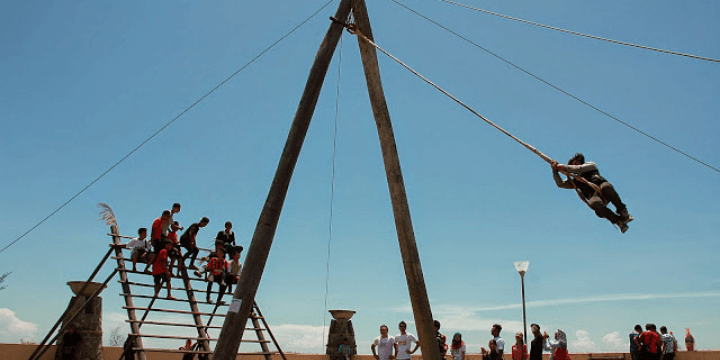
The Tibow - a 20 ft swing. Image source via jiaqi0308.blogspot.com
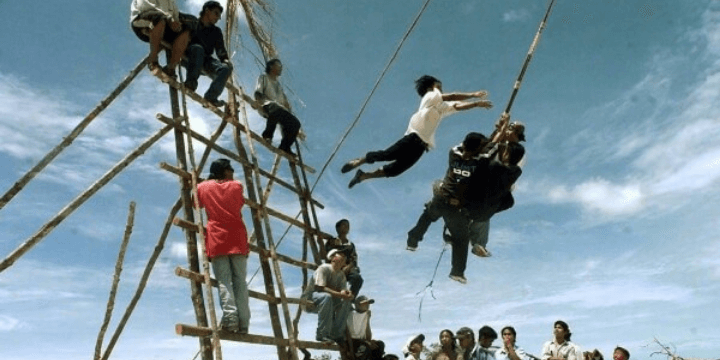
A daredevil's game Image source via iloveborneo.my
The start of Kaul is signalled by the sounding of a gong informing the whole community that Kaul is going to be held. The first announcement is made seven days before the actual ceremony. This provides sufficient time for the necessary preparations or ritualistic paraphernalia and special food to be taken to the site of the ceremony. A second announcement is made three days prior to the festival. Normally, the gong is sounded (usually in a boat going downriver) between seven and nine o'clock at night when everybody is at home.
Traditionally, from this time, until three days after the Kaul, the village would be in palei (observance of taboo) with people are forbidden from entering or leaving it or passing it, thus isolating it from the world.
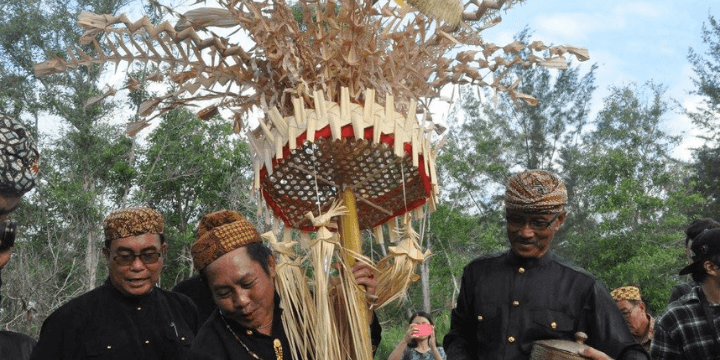
Bapa Kaul is raising the Seraheng Image source via Persatuan Melanau Mukah
Besides, no trees could be felled in the vicinity of the village. And above all, no blood could be shed which refers to any slaughtering or killing of animals for food. In the past, food for spirits and human was prepared for the occasion by every household. On the day of Kaul offerings for the spirits were placed in the appropriately decorated flat round basket called seraheng which was raised on a bamboo pole.
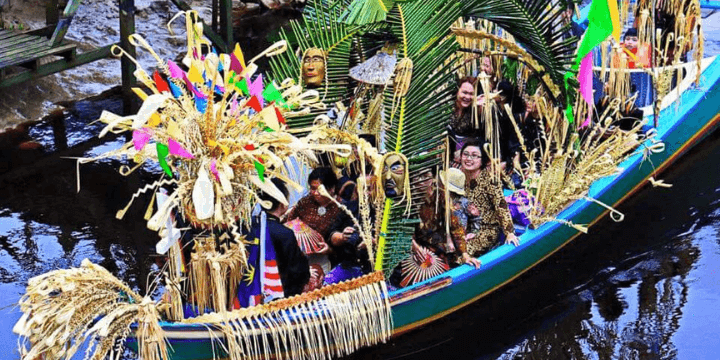
Best decoration canoe at the Kaul Festival Image source via FB/catsfm
Following preliminary chants and invocation, the seraheng would be brought in the procession by boat upriver through the village accompanied by all the members of the village. For this purpose, canoes were lashed together in lines of three, with a gong orchestra in the front three boats accompanying the chants of the ritual leader. The ritual leader (in his chants) would invite the spirits to join the villagers in a meal and then be implored to depart to their own domains after. Smaller canoes would accompany the flotilla manned by young men in masks and fancy dress representing the spirits. When the flotilla returned to the downstream point of departure, the seraheng was planted in the earth on the river bank.
Offerings were placed on the ground by it, and the young, sick and elderly would gather together under the close to the seraheng so that the water poured by the ritual leader over the offerings would fall on them and ritually wash away all that was bad and unclean. Then food brought from the home of all those present at the ceremony was served to all, ideally to be finished without remainder. Any left-over could not be taken home but would leave in the seraheng.
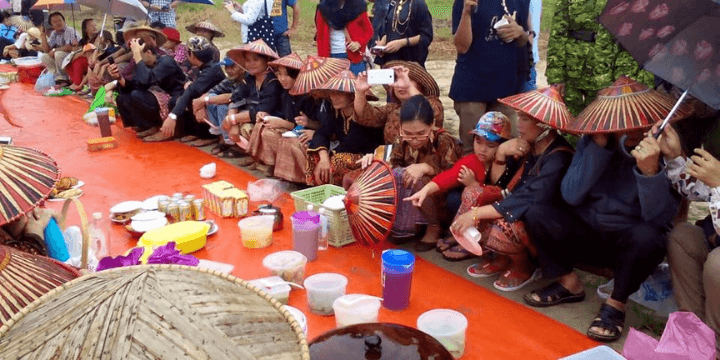
Communal Feasting Image source via FB/Borneo
With this communal feast, the ceremony would come to an end, and the villagers would depart for their families in silence to observe another three days of palei (taboo). Non-observance of the palei resulted in a ritual fine to offset the imbalance resulting from such a breach. Some of the rituals are not carried out anymore for religious reasons. However, incantations and the use of seraheng are maintained because the seraheng is the most essential item in the Kaul ceremony. Without seraheng, there is no Kaul.
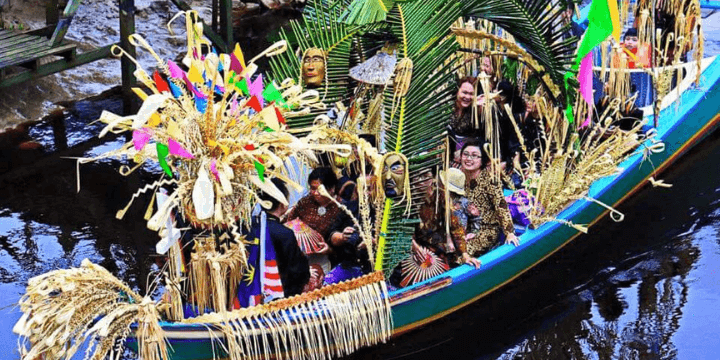
Boat decoration contest Image source via FB/catsfm
Watch the video here by Pesta Kaul Mukah and Persatuan Melanau Mukah.