Louis Vuitton, definitely one of the powerhouses of the luxury world. Many may not know the history behind Louis Vuitton and how he revolutionised the packing industry.
HOW IT ALL BEGAN
The story began in 1835 when the young 14-year-old Louis Vuitton left his family in Jura and started travelling on foot to Paris. It took him nearly two years to reach Paris. To survive, he took many odd-jobs along the way before successfully landing a job in Paris as an apprentice for the famous box maker and packer Romain Maréchal.
THE ROYALS AND ELITES
Maréchal was impressed with the young Vuitton's diligence and perseverance from the start. Within a few years, Vuitton became one of the best packers in the city. In 1853, he was appointed as the personal packer and box-maker for Empress Eugéni, wife of Napoleon Bonaparte. This made young Vuitton the most sought-after craftsmen amongst the rich and royals in Paris.
In 1854, Louis Vuitton set up his shop on 4 Rue Neuve-des-Capucines, Paris. He offers special packaging for the most fragile objects. At that time, horse-drawn carriages, boats and train were the main modes of transportation and baggage was handled roughly.

The very first Louis Vuitton trunk in Trianon canvas in 1858. Image source via lifestyleasia.com
REVOLUTIONISED PACKING DESIGN
Louis Vuitton was very innovative in his trunk design. In 1858, he introduced the very first flat top and bottom trunk design that no one has actually seen before. Previously it has always been arched top to prevent the water from seeping in. With Vuitton's design, not only it is stackable, but also lighter and easier to transport because he used sturdier poplar wood.
Vuitton also used waterproof pearl grey canvas, Trianon instead of the traditional leather. The tradition leather easily cracked and prone to mould and bad odour. The flat trunk was an instant success. Due to the demands, Vuitton decided to expand his production to the city of Asnières in 1859.
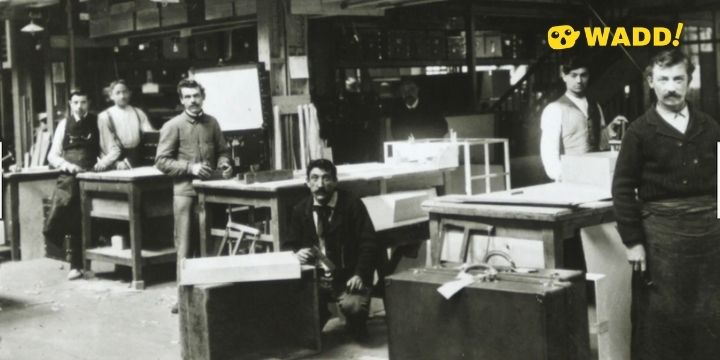
Louis Vuitton: Asnières site Image source via eu.louisvuitton.com
Louis Vuitton didn't stop at that particular trunk design. He continued to innovate and improve the strength and lightness of their creation. He also revitalised fabrics and patterns like the striped canvas called Rayée and checkered pattern - Damier to fight against counterfeits.

Clockwise from top left: the Monogram canvas from 1896, the Damier canvas from 1888, the Trianon grey canvas from 1854, and the striped canvas from 1872. Image source via lifestyleasia.com
Louis Vuitton also specialises in customising design tailored to the needs of the new generations that are constantly on-the-go. Like the vertical steamer trunk (1875), a light portable wardrobe complete with drawers, compartments and hanging space, suitable those always travelling without the need to unpack at all.
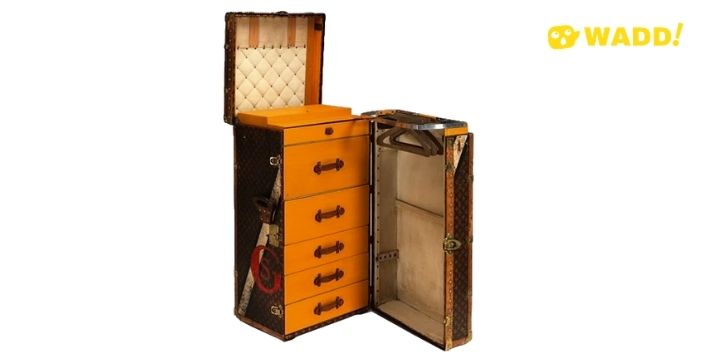
A deluxe wardrobe steamer trunk by Louis Vuitton from 1913. A complete Monogram canvas wardrobe that belonged to Sacha Guitry. Image source via lifestyleasia.com
REVOLUTIONISED THE UNPICKABLE LOCK
George Vuitton, the son of Louis Vuitton, was the monogram canvas creator, the juxtapose pattern and the "L" and "V" initially canvas. He also added an invaluable invention that guaranteed the impenetrable lock - known as tumbler lock. In 1886, George adopted a single lock system in every trunk. He also patented this revolutionary system.
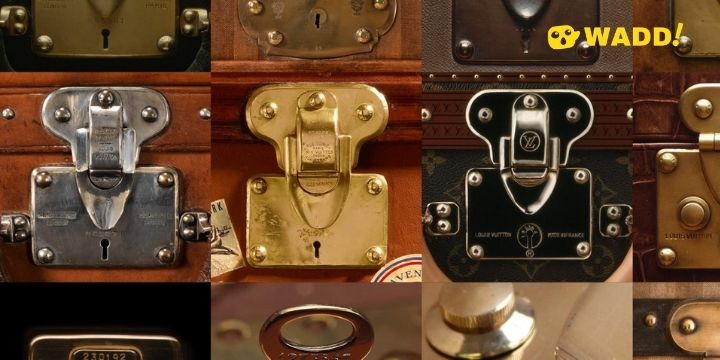
The Tumbler lock Image source via eu.louisvuitton.com
Fun fact: He even challenged Harry Houdini, the great American escape artist in a public newspaper to escape from a Vuitton box and lock.
WORLD WAR I AND BEYOND
During World War I, Louis Vuitton's factory was forced to shut down but by late 1920s, orders from the world's richest and stylish including Coco Chanel and the Duke and Duchess of Windsor began to come in. From 1930, it expanding into travels bags including the Keepall bag, the Noé bag (designed to transport five bottles of champagne) and the Steamer bag (used to keep dirty clothes separate from clean ones).
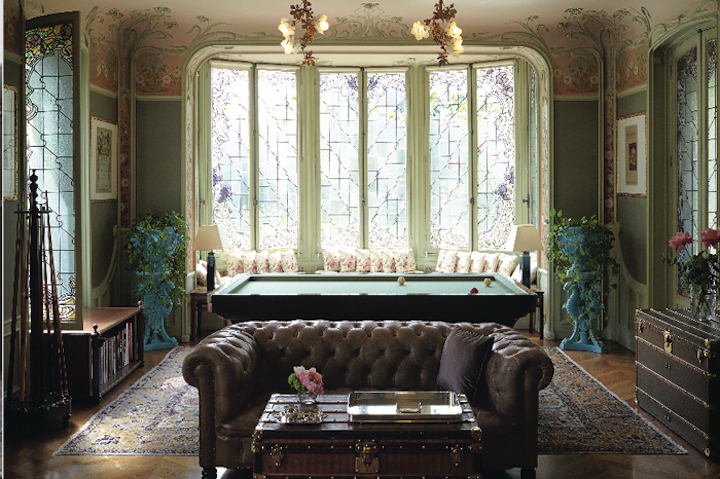
Louis Vuitton: Asnières Site Image source via lifestyleasia.com
The original atelier has since then been expanded throughout the decades including the Vuitton family residence. It is still where products are crafted today. While the family home has been preserved and converted into a private museum. Around 170 craftsmen work in the Asnières workshop, designing and creating leather goods and special orders for clients worldwide.
The Louis Vuitton brand and the LV monogram are among the world's most valuable brands. According to a Millward Brown 2010 study, Louis Vuitton was then the world's 19th most valuable brand and was estimated to be worth over US$19 billion.
Reference: