
The Wind Cave Nature Reserve is part of the Bau Formation, a narrow belt of limestone covering about 150 sq km of Southwest Sarawak. Due to the comparatively soft and soluble nature of limestone, and the intense tropical rainfall of the region, the whole of the Bau Formation is intersected with caves.
Whilst many caves of the Bau Formation are remote and inaccessible, the Wind Cave is within half an hour's drive from Kuching and is a popular day trip and picnic destination. It is located only five kilometres from the former gold mining settlement of Bau.
Wind Cave at Bau meanders through a rocky outcrop on the banks of the Sarawak River covers 6.16 hectares and includes the cave itself and the surrounding forest.
Flora And Fauna
The Wind Cave’s has been gazetted as a nature reserve not just to protect the cave and its inhabitants, but also to conserve a number or rare species in the surrounding limestone forest. Amongst the small to medium-sized trees and shrubs are some very rare palms, including Arenga pinnata (called Inyok in the local Bidayuh language), Arenga undulatifolia (Opip in Bidayuh) and the gigantic Calamus ornatus (Wi jelayan in Bidayuh).
Squirrels, shrews and a variety of birds can be found along the river and the limestone hill. Black nest swiftlets can be seen and heard inside the cave, as well as 14 species of bat. Twelve distinct species of snail have also evolved in the caves and the covering hill, each unique to its limestone habitant.

Wind Cave - Just look at those beautiful chamber wall!
Exploring The Cave
The Wind Cave is believed to have got its name from the cooling breeze blowing continuously through the cave. It a smooth, tubular limestone cave formed during the Jurassic-Cretaceous period, roughly sixty million years ago. Excavations by early explorers such as Beccari in 1865 have shown that the Wind Cave was inhabited until recent times. Earthenware vessels, charcoal and pieces of marine and freshwater shells were found. The deep pits within the cave may have been made by gold prospectors in the 1930s.
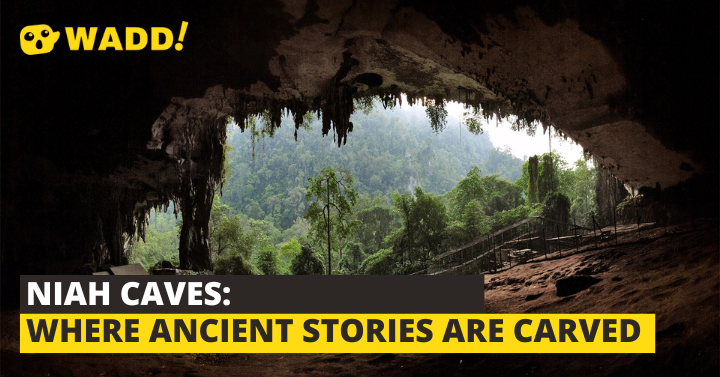
A one thousand metre plank walk runs throughout the length of the cave, so it is easy and safe to explore, although the interior of the cave is unlit and therefore a flashlight is essential. A small stream meanders through the cave and joins the Sungai Sarawak Kanan at the northern end. The main cave passages are wide with flat roofs, while the shorter passages form an irregular network in the northern section of the cave.

Image source via interestingplace1.blogspot.com
The Wind Cave’s main features include stalagmites, stalactites and pillars, which form when these two join together. Other features include conical cavities separated by blade-like pinnacles of limestone, limestone pendants hanging from the roof of the cave passage and current scallops which have a honeycomb appearance and indicate the direction of the water flow.
Throughout the length of the cave, the high-pitched squeaking of thousands of bats can be heard, including a number of insect-eating species, as well as a large population of Dusky Fruit Bats. There are also thousands of Black Nest Swiftlets nesting in the cave, and their nests, made almost entirely from the swiftlets’ glutinous saliva, can be seen adhering to the nooks and crannies of the upper cave wall.
At the end of the cave passage, the plank walk emerges onto the hillside and a path leads down to the bank of the Sungai Sarawak Kanan, one of the two major tributaries of the Sarawak River. There is a narrow sandy beach along the riverbank, with public changing rooms, so this is the perfect place to swim and cool off after visiting the cave. There is also a picnic area and some stalls selling snacks and drinks.
In collaboration with Sarawak Forestry
Update from Sarawak Forestry: Redevelopment project for both Wind Cave and Fairy Cave Nature Reserve effective 18th March 2019 until 14 January 2021. During the construction period, Fairy Cave NR and Wind Cave NR are fully closed.